Seiza is a library and a CLI — which is great if you’re integrating it and useless if you just want to know where your photo points. So now there’s seiza.fyi: drop in a FITS or ordinary image, and find the patch of sky in your image.
Upload a file (hints for RA/Dec/pixel scale are optional — leave everything blank for a blind solve), and the job queues to a background worker. You immediately get a durable solution page at an unguessable URL you can bookmark or share: the uploaded image and preview expire after about a day, but the solution — full WCS, quality metrics, and catalog annotations — sticks around.
Here’s a real run: I gave it my comet Lemmon frame with no hints at all. A blind solve later:
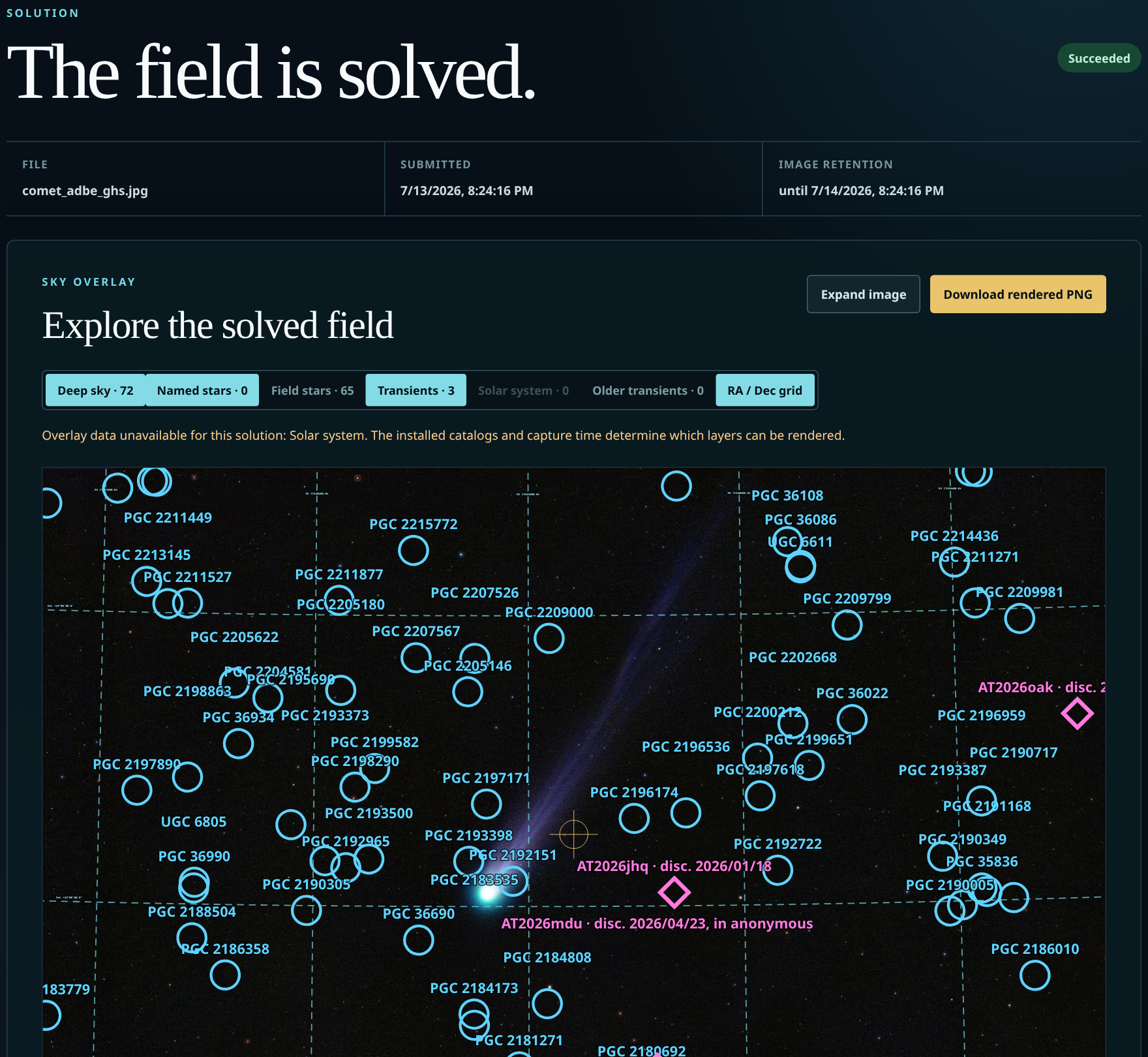
The field is solved. The interactive overlay draws 72 deep-sky objects, 65 matched field stars, three active transients, and an RA/Dec grid over the frame — with layer toggles, an expandable view, and a one-click rendered PNG download. (Fair warning from my own testing: a bare blind solve of a sub-degree field is asking a lot — that’s exactly what the optional hint fields are for. Wide fields sail through.)
Under the hood
The server — seiza-server,
open source like everything else — uses the published seiza crates
directly, no CLI subprocess. The job queue is durable (SQLite locally,
PostgreSQL or DynamoDB for bigger deployments): a slow blind solve never
ties up the HTTP handler and never disappears on a restart. The server limits requests per client with a token bucket. A weighted-LRU
queue gives an unseen client priority so one client cannot monopolize it.
And for existing tooling, there’s an astrometry.net-compatible API
subset — login, upload, submissions, jobs, calibration — so
software that already speaks astrometry.net can point at a seiza-server
instead. Between this and the CLI’s ASTAP-compatible mode, you can now
use seiza in an imaging workflow as a library,
binary, or service.
Try it: seiza.fyi/solve.